
What makes a company decide to move its IT infrastructure from an in-house server room to a professional data center? What problems need to accumulate before management concludes that the change is unavoidable?
Below is a ranking of the five most common reasons for migrating to data centers, based on real conversations with clients. This is not textbook theory. These are concrete, everyday challenges that increasingly disrupt operations — and eventually force a strategic shift.
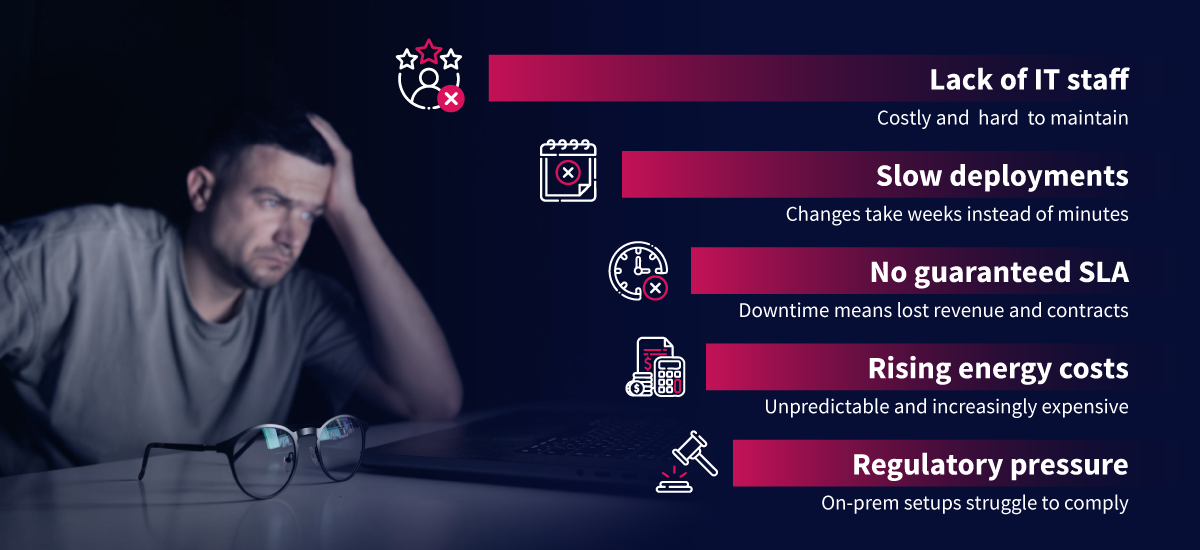
1. Lack of IT specialists to manage in-house infrastructure
This is the most common reason. A company has servers in a basement or a small rented server room. Someone needs to manage them: install updates, monitor performance, respond to failures, configure new services. The problem? There is no one to do it.
The IT job market is unforgiving. Skilled system administrators are scarce. Those available command high salaries. And those already employed often leave after a year or two for more attractive projects and higher pay.
Companies without sufficient IT staff face a difficult choice: either continuously increase spending on hard-to-retain talent, or hand over infrastructure management to a professional provider with an established team of experts.
This is not about whether infrastructure can be managed internally. It’s about whether it makes economic sense. Why invest in hiring, training, and retaining individual specialists when access to an entire expert team can be part of a data center service?
This is especially true for companies outside the tech sector. A furniture manufacturer, logistics company, or law firm does not exist to run IT infrastructure. Server management is a non-core cost. It is far more efficient to focus resources on core business activities and leave infrastructure to specialists.
2. The need for faster time-to-market for new services and features
Markets move faster than ever. A company that launches a product or feature a month later than its competitors may lose the market entirely.
In-house server rooms are typically bottlenecks. Need more computing power? You must purchase a server — ordering, delivery, installation, configuration. Six weeks, if you’re lucky. Need a new test environment? You wait again for someone to find time to set it up.
Professional data centers offering IaaS or PaaS eliminate these delays. Need resources? You get them in minutes. Need a test environment? You launch it within an hour. No hardware purchases, no delivery delays, no physical installation.
This is not a matter of convenience — it’s a competitive advantage. A company that can deploy a new feature in one week instead of two months wins customers. A company that can test ten ideas and launch the three best ones — while competitors test only one — has a much higher chance of meeting market needs.
In 2026, speed of innovation is a critical success factor. That is why time-to-market ranks second among the reasons for migrating to data centers.
3. Inability to guarantee required availability levels (SLA)
B2B customers increasingly demand guaranteed service availability of 99.9% or higher — meaning a maximum of about eight hours of downtime per year. For mission-critical systems, even less.
In-house server rooms rarely meet these standards. Limited power redundancy, a single internet connection, no automatic failover. When something breaks, systems go down — and stay down until repairs are completed.
Professional data centers are designed for high availability: multiple layers of power, network, and cooling redundancy, automated failover mechanisms, and expert teams available 24/7. SLAs are contractually defined — with financial penalties if they are not met.
For many companies, the inability to guarantee SLA is not just a technical issue — it’s a legal one. Customer contracts may include penalties for downtime. Industry regulations may require specific availability levels. Companies that cannot guarantee them lose contracts.
That is why the inability to ensure SLA ranks third among migration drivers.
4. Rapidly rising energy costs and lack of cost predictability
Energy is one of the largest operating costs of an on-premise server room. Servers consume power. Cooling systems consume power. UPS systems consume power. And energy prices — particularly in Europe — continue to rise.
Companies with in-house server rooms have limited options to reduce these costs. Replacing old servers with energy-efficient models requires capital. Optimizing cooling requires expertise and investment.
Professional data centers operate at a scale that enables optimizations unavailable to individual companies. They use advanced cooling systems, renewable energy sources, and intelligent power management. They measure efficiency using PUE (Power Usage Effectiveness) — and are financially incentivized to improve it.
More importantly, companies using data centers gain cost predictability. Instead of volatile energy bills that may increase by 50% year-over-year, they pay a stable, predictable fee. This simplifies budgeting and reduces exposure to energy price fluctuations.
Rapidly rising energy costs and lack of financial predictability rank fourth among migration drivers.
5. The need for regulatory compliance (NIS2, DORA, KNF)
Europe is introducing increasingly strict cybersecurity and data protection regulations. The NIS2 Directive, DORA regulation for the financial sector, and requirements from the Polish Financial Supervision Authority (KNF) all impose concrete obligations on organizations.
These often include physical security, system redundancy, access controls, security audits, and incident response procedures. A server room located in an office building rarely meets these standards without significant investment.
Professional data centers are designed with regulatory compliance in mind. They hold certifications such as ISO 27001 and ISO 22237, maintain documented security procedures, and meet auditor expectations. Companies using such facilities can effectively “inherit” part of this compliance instead of building everything from scratch.
Importantly, non-compliance is not only a financial risk. It may result in loss of licenses, contracts, or reputational damage.
Still, compared to the first four drivers — lack of specialists, speed requirements, SLA constraints, and energy costs — regulatory compliance ranks fifth. Why? Because it primarily affects specific industries (finance, healthcare, critical infrastructure, public sector), while the first four impact almost every organization.
What These Priorities Reveal About the Changing Role of IT
This ranking highlights a fundamental shift: IT is no longer seen as a technical support function — it has become a core element of business strategy.
In the past, migration to data centers was justified by arguments such as “better security” or “higher reliability.” Important, but abstract. Hard to measure, harder to justify budget decisions.
Today’s arguments are concrete and business-driven: we lack staff, we are too slow, we are losing contracts, costs are spiraling out of control. These are problems executives immediately understand.
The most telling insight is that lack of IT specialists ranks first. It reflects how dramatically the labor market has changed — and how difficult it has become to manage infrastructure internally.
In 2026, companies are no longer asking “Should we move our infrastructure to a data center?”
They are asking “When — and how fast can we do it?”