
In most companies, there comes a moment when technology stops supporting growth and starts slowing it down. This doesn’t happen overnight—it’s a gradual process. Today, launching a new feature takes a week longer than planned. Next month, the sales team complains that the system has frozen again. A quarter later, it turns out competitors are innovating faster.
The problem is that these warning signs are often ignored or rationalized. “That’s normal in our industry.” “We have an old system, but it still works.” “IT is always expensive.” Then one day, the company loses a tender because it can’t guarantee the required SLA. Or it loses a customer because a competitor launched a new service in a week—while it needs three months.
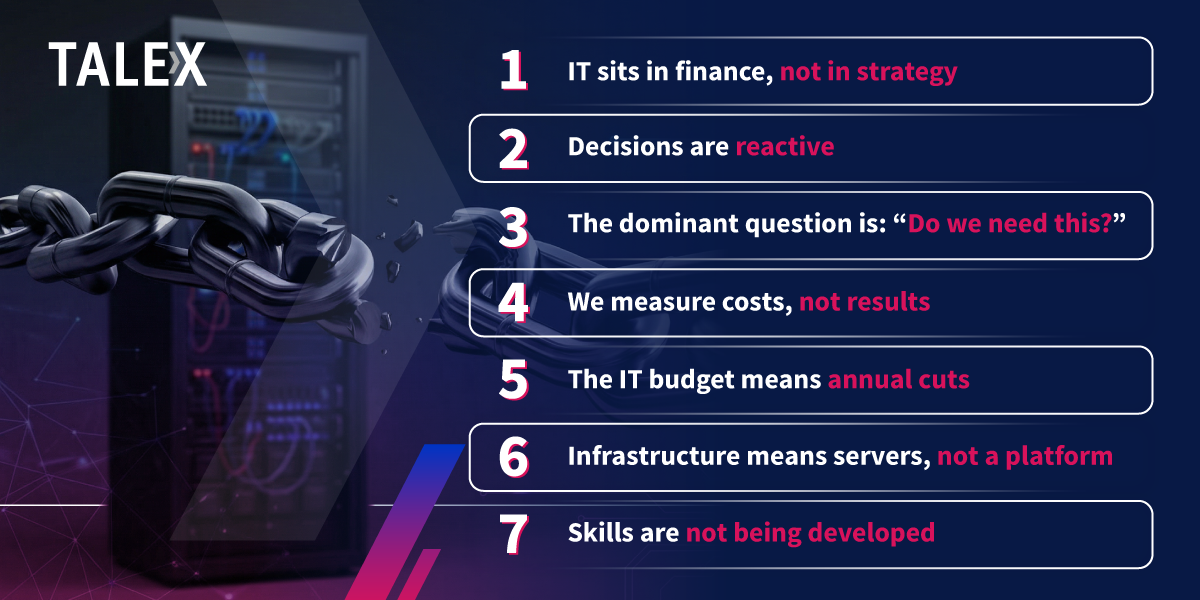
Here are seven measurable signals that technology in your organization has stopped being a growth enabler and has become a burden—and, more importantly, what to do about it.
1. New features take months instead of days or weeks
The business team raises a request: a new application feature, a process change, an integration with a partner system. And then the waiting begins. Planning. Specifications. Testing. Deployment. Three months later, the feature reaches users—but the market has already moved on, and competitors are ahead.
Long deployment cycles are a symptom of infrastructure that isn’t built for change. When every modification requires manual server configuration, dependency installation, and cross-team coordination, the organization loses momentum.
Companies that treat technology as a competitive advantage deploy new features in days, not months. They rely on automated processes, ready-to-use environments, and platforms that allow developers to focus on code rather than infrastructure management.
2. The IT team spends most of its time “putting out fires” instead of developing systems
Ask the IT manager what they worked on this month. If the answer is “fixing outages, configuring servers, installing patches”—that’s a red flag.
IT teams should create business value: building new features, improving processes, implementing automation. If 80% of their time goes into keeping existing systems alive, the organization isn’t developing technology—it’s fighting for survival.
This usually stems from aging, complex infrastructure. Servers require manual maintenance. Systems are so critical that no one wants to touch them. There’s little automation, so even routine tasks take hours.
Organizations that treat technology as an advantage automate routine work and use managed platforms. Their IT teams can focus on business projects because infrastructure doesn’t require constant attention.
3. IT costs grow faster than company revenue
The company grows by 15% year over year. IT costs grow by 30%. That’s unsustainable math.
This often happens when infrastructure doesn’t scale efficiently. The company buys more servers, hires more administrators, pays for more licenses—without a proportional increase in performance or business capability.
This is especially painful for companies running their own server rooms. Every increase in demand requires buying hardware that sits underutilized most of the year but must be purchased “just in case.” Power, cooling, maintenance—all add up.
Organizations that treat technology as an advantage optimize costs through flexible models: they pay only for what they use, scale resources up and down as needed, and leverage the economies of scale of professional data centers.
4. The company cannot guarantee appropriate availability levels (SLA)
A customer asks: “What is your guaranteed service availability?”
The answer: “We try to run 24/7, but… well, things happen.”
The lack of clear, measurable SLAs (Service Level Agreements) signals that the organization doesn’t control its infrastructure. It doesn’t know actual uptime. It lacks preventive processes and disaster recovery plans.
In many industries, this is no longer acceptable. B2B customers expect 99.9% availability or more. E-commerce businesses lose revenue with every minute of downtime. Public institutions must meet regulatory requirements.
Organizations that treat technology as an advantage design infrastructure for high availability: redundancy, automatic failover, monitoring, backups. And they can guarantee specific numbers—because they measure and control them.
5. Difficulty hiring and retaining IT specialists
“We can’t find a good system administrator. And those we hire leave after a year.”
This isn’t just a labor-market problem. It’s also a signal that the organization expects IT teams to do work no one wants: managing outdated infrastructure, manually configuring servers, working weekends during outages.
Top specialists want to work with modern technologies, automate processes, and develop skills. If a company offers them old servers in a basement, they’ll choose the competition.
Organizations that treat technology as an advantage attract talent by offering a modern working environment. IT teams solve business problems instead of manually patching infrastructure.
6. Scaling requires hardware purchases and months of waiting
The company signs a major contract. Forecast: traffic will double.
IT’s response: “We’ll need new servers. Please approve the budget. We can be ready in three months.”
In today’s business pace, three months is an eternity. Competitors may launch similar services, the market may shift, and customers may lose patience.
Companies relying on their own infrastructure must always predict future demand and buy hardware in advance—leading either to underinvestment (systems slow down under load) or overinvestment (unused servers sitting idle).
Organizations that treat technology as an advantage scale resources elastically. Need more capacity? You get it in minutes, not months. Don’t need it anymore? You release it and stop paying.
7. Lack of IT automation and constant manual work
Ask how a typical system update is deployed. If the answer includes “manually,” “we log in,” “we configure each server one by one”—there’s a problem.
Modern IT infrastructure should be highly automated. Deployments, scaling, backups, monitoring, incident response—everything should work automatically with minimal human intervention.
Manual work doesn’t just waste time; it introduces risk. When an administrator manually configures 20 servers, the chance of error is high. One mistake can bring the entire system down.
Companies that treat technology as an advantage invest in automation. IT teams build scripts, tools, and processes that run on their own—freeing resources for initiatives that generate business value.
What can you do about it?
If your organization recognizes several of these signals, it’s time for a strategic decision.
Option one: invest in modernizing your own infrastructure. Buy new servers, hire specialists, implement automation, build processes. This is possible—but it requires significant capital and time. And it doesn’t eliminate the core issue: the company still manages infrastructure instead of focusing on the business.
Option two: move to a platform-as-a-service model. Shift infrastructure to a professional data center, use IaaS or PaaS, and let the provider manage hardware, systems, and availability. The company focuses its resources on what truly creates value: product development and customer service.
It’s not an easy decision—it requires analysis, planning, and gradual migration. But for many organizations, it’s the only way to ensure that technology stops being a burden and becomes a growth engine once again.